

ADHD: Not about knowing what to do, but doing what we know

From left: Andrew Pe, Hannah Dong-As, Moonlake Lee, myself and my daughter Jaycie, encircled with the arrow pointing to her – who will be the focus of this article today.
I first had the honor of meeting Moonlake Lee in Singapore when I networked with her a few years back. So when she came to the Philippines two weekends ago, I was happy to bring friends affiliated with the ADHD Society of the Philippines – Andrew Pe and Hannah Dong-As and just like any afternoon with multiple adults with ADHD, it was an irreplaceably wonderful time. We didn’t even need karaoke for this – it was just discussions on ADHD, getting deep into the nuances of the condition and the like. Singapore ADHD advocacy has indeed come a long way and we were even given copies of amazing resource material that they have published: Parent First, ADHD Later and Differently Wired Minds.
While this table discussion was wonderfully stimulating for the adults, my younger daughter Jaycie who is only 4 years old was understandably bored. Thus, I gave Jaycie her favorite hyperfocus object: dessert in the form of a large ube filled donut. Well-endowed said donut may have been however, it only lasted a few minutes as my sugar-loving little girl chomped away at it. After drinking water and looking satisfied, this is when Ms. Lee suddenly brought out more gifts: this time in the form of cans of cookies in unique Singaporean flavors. I picked the “Milo Dinosaur” flavored cookies, named after a popular local drink that uses Milo. Alas, with the donut plate empty and the presence of this glistening can of cookies, my daughter’s combined sweet tooth and curiosity for new shiny things overwhelmed her. She stared at the can with her big round eyes, and was drawn to the can like a moth to the flame. Not only until a few seconds later she asked me if she could have a cookie. Hyperfocused on the adult conversation happening, I simply told her that she already had a large donut! What I didn’t tell her was that seeing her big eyes (I’m sorry Jaycie when you read this in the future) staring intently and longingly was such an adorable moment for me as a dad to see – so I watched her from a distance.
Amid this endearing moment, one thought that entered my mind at this point was the famed marshmallow experiment by psychologist Walter Mischel done in Stanford in the 1960s. The researchers presented a controlled environment and preschool kids a choice: have one marshmallow now, or wait to receive even more marshmallows. Apparently they tracked outcomes later on in the lives of these kids and found that those who waited longer had better academic performance, among other things. Obviously, I’d imagine those with ADHD may not have done well in this test.
We have to remember though: this was in the 1960s. Remember that time when studying hard, getting good grades and then getting a good job out of that was a good formula for the future? See, adults with ADHD often struggle in 2026 because they are still living out the standards of the 1960s as if they were in a controlled environment. They look at all the kids around them who probably waited for the second marshmallow and think to themselves why can’t I just be like them?
Thankfully again, my daughter is being raised in 2026. This means she is vastly unaware of these normative standards that lead to a supposed picture of “success” and that she isn’t in a controlled environment. Which means that she has access to her creativity, her resourcefulness and her sense of wholeness.
Her solution to the cookie jar in front of her? She grabbed a tissue paper towel and covered her face. Picture for illustrative purposes below:
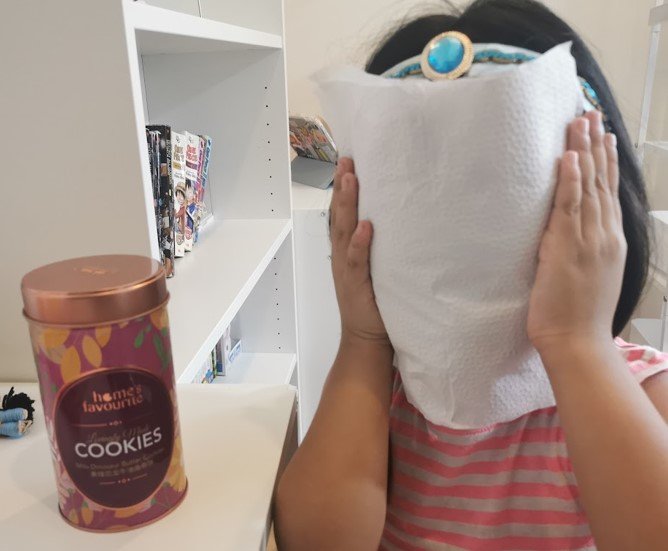
“Who stole the cookie from the cookie jar? Not me – I can’t even see it!” Disclaimer: this is a re-enactment, not the actual event Same little girl, same can (now empty) of Singaporean Milo Dinosaur cookies but thankfully, a different piece of tissue paper
This strategy isn’t new within ADHD circles either. When Ari Tuckman talked about coaching in his book “More Attention, Less Deficit”, he mentioned that "changes on the outside create changes on the inside” – that is, you have to proactively prevent problems and set your environment for success. It has many names like “out of sight, out of mind” or “proactively organizing the environment”. Children and Adults with Attention-Deficit/Hyperactivity Disorder (CHADD) even wrote several examples in their article that environmental modifications such as keeping phones on silent and out of sign, turning off the TV, and limiting gadget use and internet access to set amounts of time.
Well, my four year old daughter, again, unaware of any of these ADHD strategy concepts and theories (she’s only beginning to read), applied the concept anyway when she put the tissue paper towel on her face.
Given that we found the gesture not only helpful, but incredibly adorable, we’ve rewarded the behavior by acknowledging her creativity. Funnily enough, she does this for other opportunities such as this one:

Now, she uses tissue paper when she can’t have something she's curious about, such as my wife’s Tiramisu, which has loads of caffeine in it. Don’t worry – we got Jaycie her own dessert!
HERE’S WHAT I’M THINKING: Maybe if they had tissue paper towels in the marshmallow experiment, we wouldn’t be hating so much on ADHD today. HERE’S ANOTHER THOUGHT: In ADHD management we’re utterly focused on “new ways to cope” or “new treatment” that we might fail to recognize what we already know anyway. Dr. Russell Barkley, the most published doctor in the world when it comes to ADHD once said “ADHD is not a disorder of knowing what to do, but of doing what one knows” – so if a 4 year old can think of this, why can’t we? LAST THOUGHT: Maybe it isn’t about being like other people who can hold out for that second piece of marshmallow: but finding that tissue paper towel in our life.
One quote from Moonlake Lee during our discussions is to always respect the ADHD diagnosis. What she meant by this in context was that you think you may know the condition, but the more you know, the more you really don’t. As an ADHD coach I agree with this – and the day I decide that I know everything there is to know about this condition is the day I (probably) fail as a professional. However, I will say that my clients’ awareness is often the best starting point for coaching, rather than the coach presupposing what the client ought to be doing. For all you know, your client may have covered their face in tissue when they were young too.
This article is not AI assisted or AI generated in any way – I love writing too much to do that
Originally posted on neurodevcoach.com
